Description
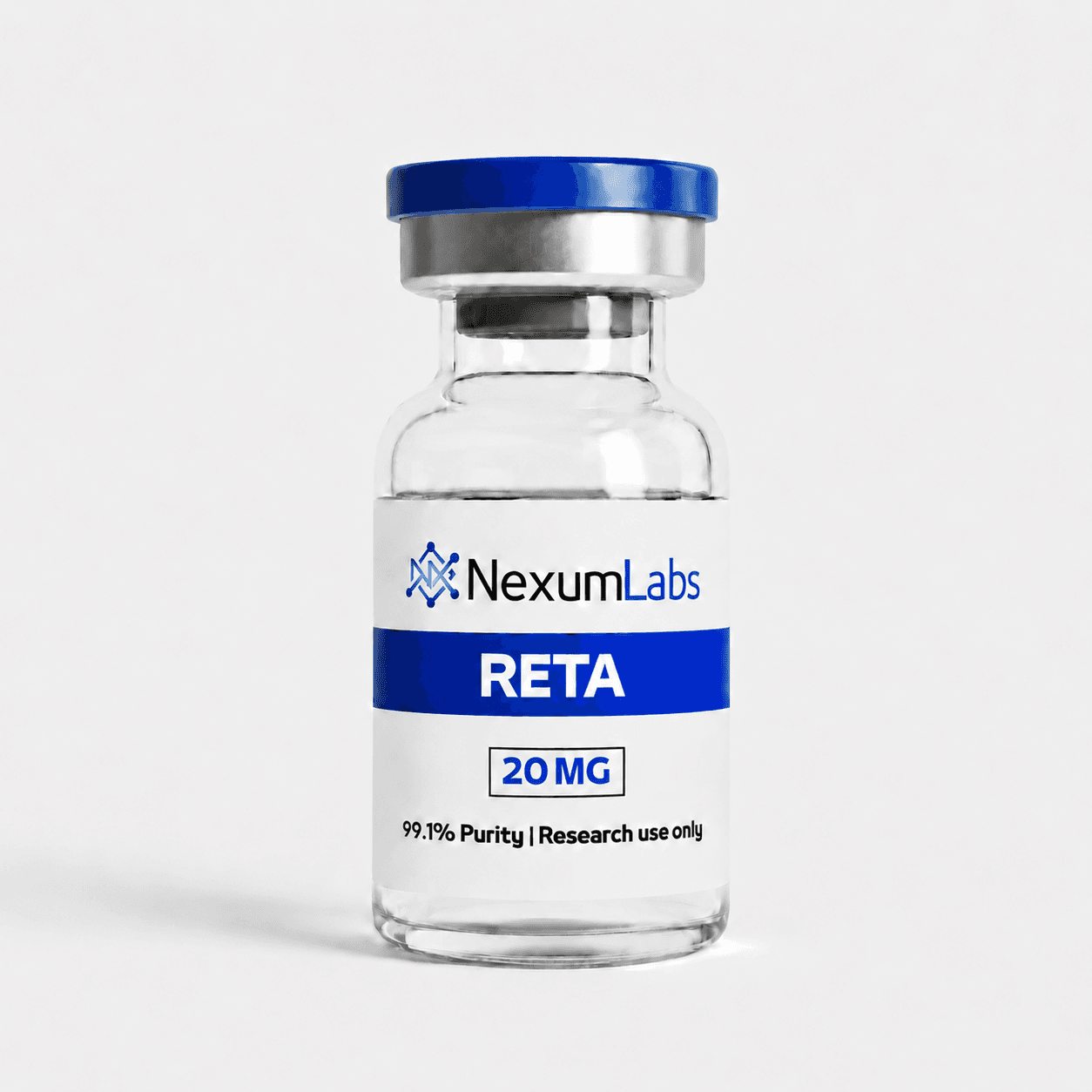
NexumLabs | Product information 01 — Description What is it? 01 / 03 Reta 10 mg Retatrutide is presented in this data sheet as a compound intended exclusively for in vitro laboratory research. Lyophilised research-grade peptide for the in vitro study of GLP-1 / GIP / glucagon metabolic pathways. Important information: Compound intended exclusively for laboratory research. 02 — Certificate of Analysis Analytical data 02 / 03 Certificate of Analysis (COA) BATCH · RETA10-001 Compound Reta · 10 mg Assay (HPLC) +99% Purity Identity (MS) Confirmed 03 — Research What has been studied 03 / 03 What it is Retatrutide (development code LY3437943) is a single peptide with agonist activity at three receptors: the glucose-dependent insulinotropic polypeptide receptor (GIPR), the glucagon-like peptide-1 receptor (GLP-1R) and the glucagon receptor (GCGR). In the discovery paper, Coskun et al. described balanced GCGR and GLP-1R activity in vitro, with greater GIPR activity [1]. It is an investigational molecule and is not approved as a medicine. Preclinical and phase 1 (2022). In obese mice, Coskun et al. observed lower body weight and improved glycaemic control, which they attributed in part to GCGR-mediated increases in energy expenditure; in a phase 1 single ascending dose study, the safety profile was similar to that of other incretins [1]. Obesity, phase 2 (2023). In a 48-week placebo-controlled trial in 338 adults, Jastreboff et al. reported dose-dependent reductions in body weight of up to 24.2%, versus 2.1% with placebo; the most common adverse events were gastrointestinal, and dose-dependent increases in heart rate were observed [2]. Type 2 diabetes, phase 2 (2023). In 281 participants, Rosenstock et al. reported reductions in HbA1c at 24 weeks and in body weight at 36 weeks, with mild-to-moderate gastrointestinal adverse events [3]. Liver fat, phase 2a (2024). In a substudy of 98 participants with metabolic dysfunction-associated steatotic liver disease, Sanyal et al. measured relative reductions in liver fat of up to 82.4% at 24 weeks, versus +0.3% with placebo [4]. Phase 3, TRIUMPH-2 (2026). In 1,152 adults with obesity and type 2 diabetes, Bellido et al. reported mean changes in body weight at week 80 of −11.9% to −18.8% across groups, versus −5.1% with placebo; gastrointestinal events, hypotension and dysaesthesia were more frequent than with placebo [5]. References Coskun T, et al. LY3437943, a novel triple glucagon, GIP, and GLP-1 receptor agonist for glycemic control and weight loss: From discovery to clinical proof of concept. Cell Metab. 2022. doi:10.1016/j.cmet.2022.07.013. PubMed 35985340 Jastreboff AM, et al. Triple-Hormone-Receptor Agonist Retatrutide for Obesity - A Phase 2 Trial. N Engl J Med. 2023. doi:10.1056/NEJMoa2301972. PubMed 37366315 Rosenstock J, et al. Retatrutide, a GIP, GLP-1 and glucagon receptor agonist, for people with type 2 diabetes: a randomised, double-blind, placebo and active-controlled, parallel-group, phase 2 trial conducted in the USA. Lancet. 2023. doi:10.1016/S0140-6736(23)01053-X. PubMed 37385280 Sanyal AJ, et al. Triple hormone receptor agonist retatrutide for metabolic dysfunction-associated steatotic liver disease: a randomized phase 2a trial. Nat Med. 2024. doi:10.1038/s41591-024-03018-2. PubMed 38858523 Bellido V, et al. Retatrutide in adults with obesity and type 2 diabetes (TRIUMPH-2): a double-blind, parallel-group, randomised, placebo-controlled, phase 3 trial. Lancet. 2026. doi:10.1016/S0140-6736(26)01861-1. PubMed 42810372 Important: For laboratory research use only. Not for human or veterinary use.